C&P EXAM PREP · PTSD
The PTSD C&P exam: what the examiner records, and how to describe it honestly
A PTSD C&P exam is the claim exam VA orders to gather evidence about your mental health condition. The examiner fills in a VA questionnaire about your symptoms and how they affect your work and your relationships, and a VA rater decides the claim later. The most useful thing you can bring is an accurate account of your worst days and your typical days.
Who does the exam, and what form they use
An initial mental health exam must be done by a board-certified or board-eligible psychiatrist, a licensed doctorate-level psychologist, or certain trainees under close supervision. The Initial PTSD questionnaire isn't public, because VA requires specialized training to use it. Two related forms are public, the Mental Disorders DBQ and the PTSD Review DBQ, and they show what the examiner covers:
- Your diagnosis, and whether symptoms can be separated between more than one diagnosis or a traumatic brain injury
- One summary line for your level of work and social impairment, chosen from the rating formula's own wording
- Your history before, during and after service: family and social life, work and school, treatment and medication, legal and behavioral history, and substance use
- A checklist of symptoms taken from the rating formula, the examiner's own observations, and whether you can manage your own money
The examiner isn't your doctor and won't treat you. They gather evidence; the rater decides.
How VA's rating rule for PTSD reads
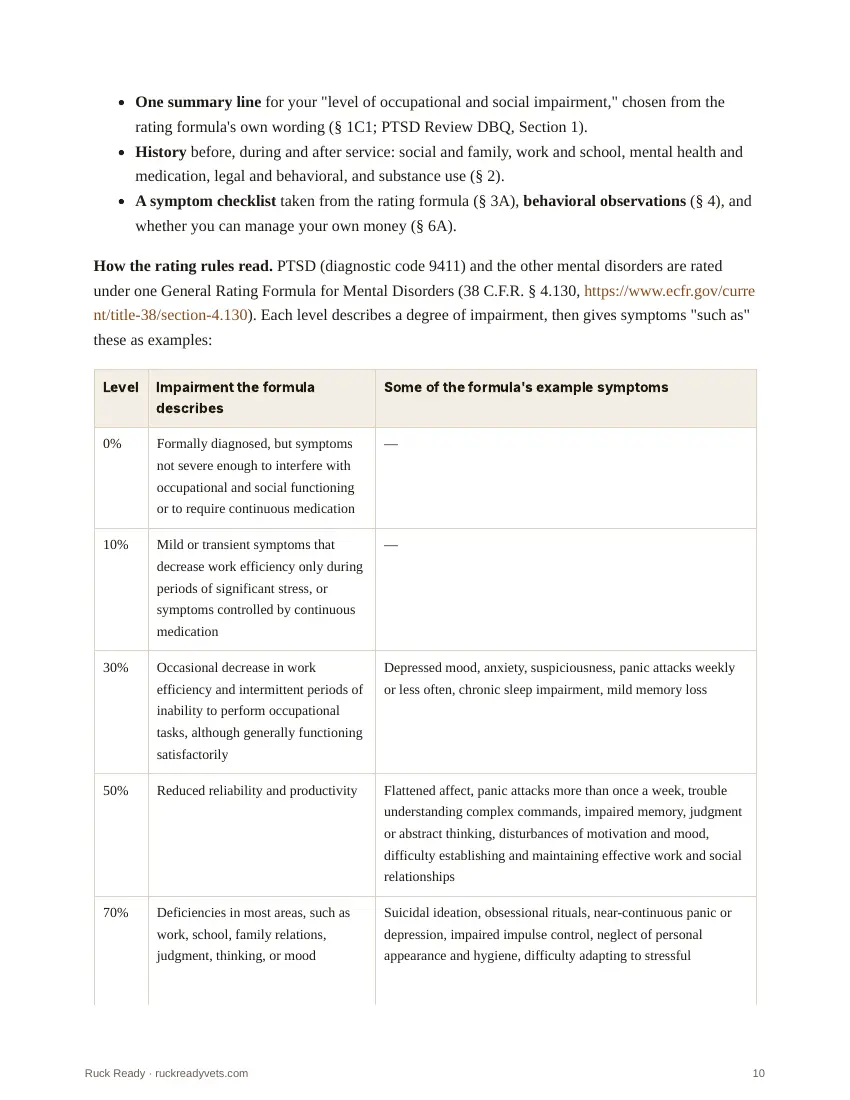
PTSD (diagnostic code 9411) and other mental health conditions are rated under one General Rating Formula for Mental Disorders, in 38 C.F.R. § 4.130. Each level describes a degree of impairment at work and in social life:
| Level | What the formula describes |
|---|---|
| 0% | Diagnosed, but symptoms not severe enough to interfere with work and social functioning or to need continuous medication |
| 10% | Mild or transient symptoms that lower work efficiency only during periods of significant stress, or symptoms controlled by continuous medication |
| 30% | Occasional decrease in work efficiency and intermittent periods of being unable to do work tasks, though generally functioning satisfactorily |
| 50% | Reduced reliability and productivity |
| 70% | Deficiencies in most areas, such as work, school, family relations, judgment, thinking or mood |
| 100% | Total occupational and social impairment |
Shortened. Each level also lists example symptoms; read the full text in the eCFR, 38 C.F.R. § 4.130 (opens in a new tab).
Two more rules matter. The rater must weigh how often your symptoms happen, how severe they are, how long they last and how long your good stretches last, and must rate on all the evidence, not only on how you seemed on exam day (38 C.F.R. § 4.126(a)). And social impairment counts, but it can't set the rating on its own (§ 4.126(b)). The listed symptoms are examples, not a checklist: what matters is how your symptoms affect your work and your life.
What not to say at a PTSD C&P exam
There is no script, and you shouldn't use one. The mistakes that hurt Veterans are about accuracy:
- Don't minimize. “I'm fine” out of habit, pride or worry about a job can land in the report as a finding. If today is a better day, say so, then describe a bad one.
- Don't guess. If you don't know how many times something happened, say so, or bring the notes you kept. A number you can stand behind is worth more than a big one.
- Don't recite the symptom list. Claiming every symptom you read online, or one you don't have, is false and damages your credibility. VA's forms warn that the law provides severe penalties for knowingly false statements.
- Do describe your worst and typical days accurately, and your good stretches too. Remissions are part of what the rater must weigh, and an honest picture in both directions is the strongest one.
How to describe your symptoms
For each symptom, give the examiner four facts: how often, how bad, how long, and what it stops you from doing. Real examples carry weight. “Chronic sleep impairment” means the hours you sleep, how often you wake, and how you function the next day.
- Work or school: missed days, warnings, conflicts, jobs you left and why.
- People: how you get along with family and friends, and what you avoid.
- Frequency and duration: panic attacks in a typical week, how long the bad stretches last, your longest good stretch this year and what ended it.
- Treatment: what medication helps with, what's left, and any side effects.
- Sensitive topics: you can ask for a male or female provider for a mental health exam or one tied to military sexual trauma. If the interview becomes too much, say so.
Bring the people who know you
You can write a short statement about your symptoms in your own words, and a spouse, friend or coworker who has seen the changes can write one too. VA counts that as lay evidence: what a person can see and describe (38 C.F.R. § 3.159(a)(2)). Our personal and buddy statement tool is free, whether or not you buy anything. It gives you the questions VA cares about and a template to finish yourself, and lets you send a buddy a private link that walks them through VA Form 21-10210.
After the exam
Write down what was asked and anything you forgot, the same day. You can't get the results at the exam; VA says to request a copy of the report with VA Form 20-10206, online, by mail or at a regional office. If you left something out, you can send it on VA Form 21-4138, in your own words.
THE FULL GUIDE
C&P Exam Prep
What the examiner is scoring, how to describe a bad day without exaggerating, and what to do the week after. The PTSD and mental health chapter starts on page 9 and runs 3 pages, with the full rating formula table and the common misunderstandings.
- How DBQs turn your words into a rating
- Flare-ups, functional loss and the questions that matter
- Chapters on six common exams: PTSD and mental health, tinnitus and hearing loss, sleep apnea, migraines, joints and back, and hypertension, with how VA's rating rules read for each
- Four fillable worksheets: a two-week symptom and flare-up log, a worst, typical and best day sheet, an exam-day card, and after-the-exam notes
- Bringing a witness, taking notes, requesting the report
- What to do when the exam went wrong
$19 one time
A 31-page PDF, yours to keep. Ask within 14 days for a full refund, no questions asked.
Ruck Ready is a trade name of ClaimScope LLC. Purchases are billed by ClaimScope LLC.
A page from the PTSD chapter
A real page from the PDF you download, not a mockup. Select it to read it full size.
 (opens the full-size page in a new tab)
What this is, and what it isn't
This page and the guide are general education about VA claim exams, written for any Veteran. They are not a review of your records, not medical advice, and not legal advice or representation; buying the guide doesn't create an attorney-client relationship. Nothing here predicts a rating or promises any result. Nothing on this page asks for your health information, and the guide never touches your records.
Free help exists too: accredited Veterans Service Organization representatives help with claims at no charge.
Sources: 38 C.F.R. §§ 3.159, 4.126, 4.130; VA's Mental Disorders DBQ and PTSD Review DBQ; VA's claim exam page (va.gov/resources/va-claim-exam). Guides are general education, not legal advice. Ruck Ready is a trade name of ClaimScope LLC and is independent of the Department of Veterans Affairs.